

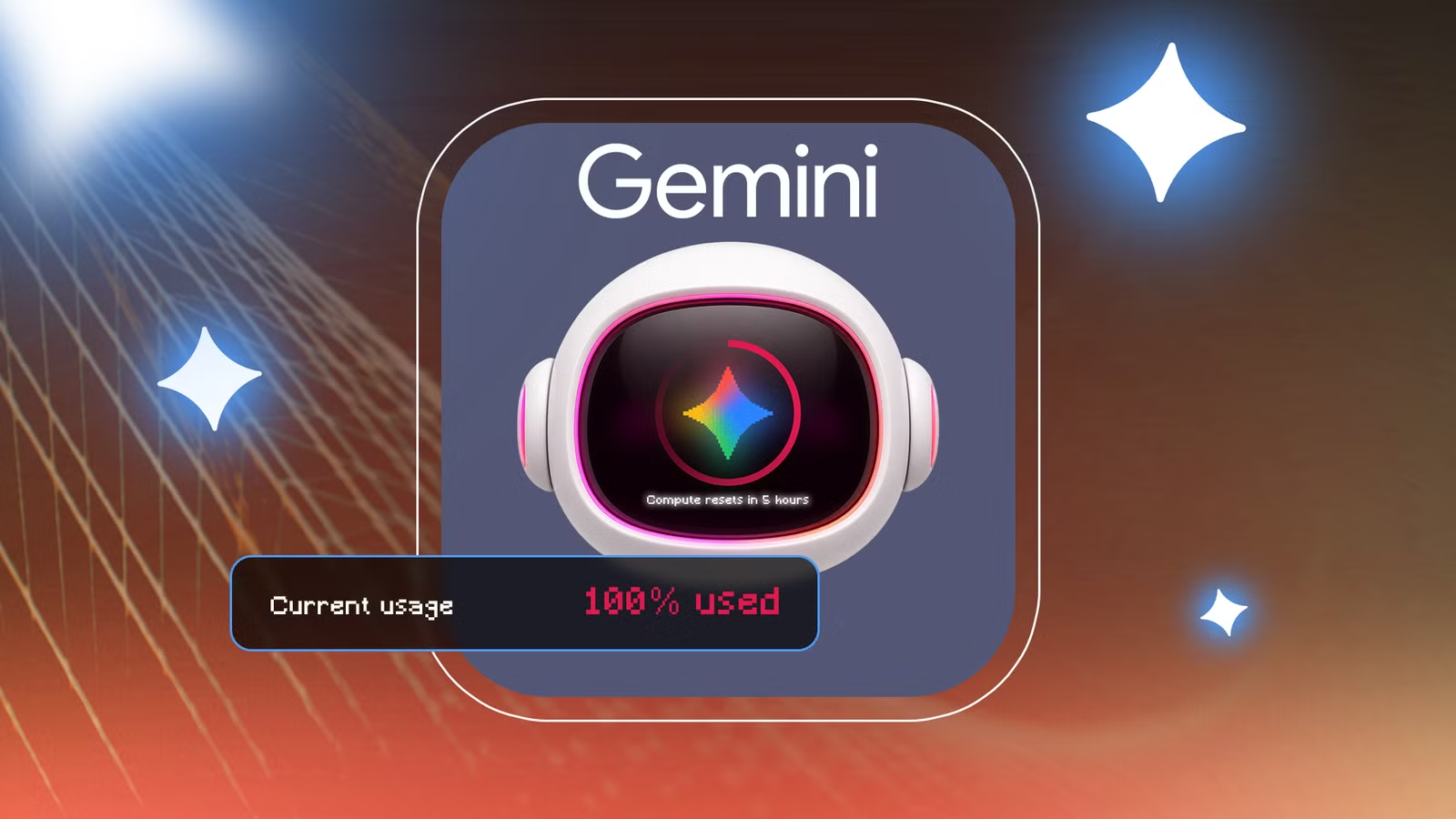

Artificial Intelligence has become an essential part of modern productivity. Whether it’s writing articles, conducting research, generating ideas, or helping with coding tasks, AI assistants are now integrated into many people’s daily workflows. Among the popular options available today, Google’s Gemini has attracted significant attention. However, over time, concerns about its compute limits and performance consistency have led some users to question whether it can be trusted as a reliable AI assistant.
One of the most important qualities of any AI assistant is consistency. Users expect similar levels of quality and accuracy every time they interact with the system. Unfortunately, compute limits can sometimes affect how an AI model performs. During periods of high demand or resource constraints, responses may become shorter, less detailed, or less accurate than expected. For users who depend on AI for important work, this inconsistency can be frustrating.
Another concern is reliability during complex tasks. Many users rely on AI assistants for detailed research, long-form content creation, technical explanations, and problem-solving. These tasks often require significant computational resources. When compute limits are reached, the AI may struggle to maintain the same depth of analysis or reasoning. As a result, users may receive incomplete answers that require additional verification or manual correction.
Trust is built through predictable performance. If an AI assistant delivers excellent results one day but underperforms the next, users may start to lose confidence in the tool. This is especially true for professionals who use AI in business, education, journalism, or software development. In these environments, even small inaccuracies can lead to wasted time and reduced productivity.
Another issue is transparency. Users generally understand that AI systems have limitations, but they also expect clear communication about those limitations. When performance changes due to compute restrictions without obvious explanation, it can create confusion. Users may wonder whether the issue is with their prompt, the model itself, or temporary system constraints.
Competition within the AI industry has also raised user expectations. Today, people can choose from multiple AI assistants, each offering different strengths and weaknesses. As alternatives continue to improve, users are more likely to switch platforms if they feel their current assistant is becoming less dependable. Reliability often becomes more important than having the most advanced features.
That said, compute limits are not unique to Gemini. Nearly every large-scale AI system must balance performance, costs, and resource availability. The challenge lies in ensuring that these limitations have minimal impact on the user experience. Companies developing AI technology constantly work to improve efficiency and scalability, but achieving perfect consistency remains difficult.
For many users, the issue is not that Gemini lacks capability. In fact, it can be highly effective for a wide range of tasks. The concern is whether it can consistently deliver high-quality results when users need them most. When reliability becomes uncertain, trust naturally declines.
Ultimately, choosing an AI assistant depends on individual needs and expectations. Some users may find Gemini perfectly suitable for their workflow, while others may prefer alternatives that offer more predictable performance. What matters most is confidence in the tool being used. An AI assistant should feel dependable, responsive, and capable of handling important tasks without significant fluctuations in quality.
As AI technology continues to evolve, providers must focus not only on innovation but also on consistency and trust. Advanced capabilities are valuable, but users are more likely to remain loyal to platforms that deliver reliable results day after day. For those who have experienced performance issues related to compute limits, rebuilding that trust may require significant improvements in transparency, stability, and overall user experience.
Phone Heating While Charging: Causes, Solutions & Safe Charging Tips (2026 Guide)
#GeminiAI #ArtificialIntelligence #AITools #ChatGPT #Technology #Productivity #MachineLearning #AIAssistant #DigitalTools #TechNews










Comments 1